

When you're managing a contingent workforce, the last thing you need is doubt about whether your staffing partner is truly working in your best interest. Yet that's exactly the position many healthcare organizations find themselves in when working with agency-owned MSPs.
The problem isn't always obvious. Your MSP might deliver acceptable results while quietly prioritizing their own staffing agencies, inflating costs, and limiting your access to the best talent. This is the conflict of interest inherent in non-neutral staffing models, and it's more common than most procurement leaders realize.
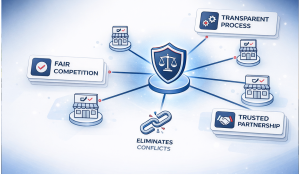
Here's the short version: vendor neutral staffing eliminates these conflicts by removing the financial incentive to favor any particular staffing agency. The result is fair competition, transparent processes, and typically 8-15% cost savings in the first year.
Let's break down how this works and why it matters for your organization.
What is Vendor Neutrality in Staffing?
Vendor neutrality in staffing means your Managed Service Provider (MSP) or Vendor Management System (VMS) operates with zero affiliation to any staffing agency. There's no ownership stake, no parent company relationship, and no financial incentive to prioritize one supplier over another.
Pure vendor neutrality only exists when the MSP has no staffing capability whatsoever. This matters because the moment an MSP can fill requisitions with their own candidates, a conflict emerges. They're no longer solely focused on finding you the best talent at the best price. They're also motivated to maximize their own staffing revenue.
Here's how a truly vendor-neutral model works:
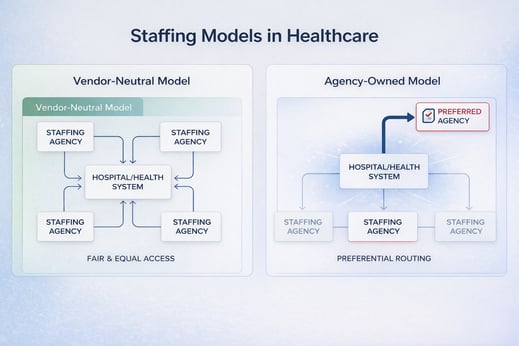
- All vendors compete equally. Job requisitions are distributed to approved staffing agencies using client-defined rules, not MSP preferences.
- Selection is objective. Candidates are evaluated on qualifications, availability, and cost, not on which agency submitted them.
- The MSP works for you alone. Their only revenue comes from managing your program, not from placing candidates.
The concept has become an industry standard in contingent workforce management because it addresses a fundamental trust issue. When you engage an MSP, you want confidence they're acting in your best interests. Vendor neutrality provides that confidence by design.
Ringo operates as a vendor-neutral VMS, meaning healthcare organizations maintain full control over their staffing decisions without worrying about hidden biases in the process.
The Hidden Conflicts in Agency-Owned MSPs
To understand why vendor neutrality matters, you need to see how conflicts of interest actually manifest in agency-owned models. These aren't theoretical concerns. They're documented, measurable problems that affect your costs, talent quality, and operational efficiency.
The Financial Incentive Problem
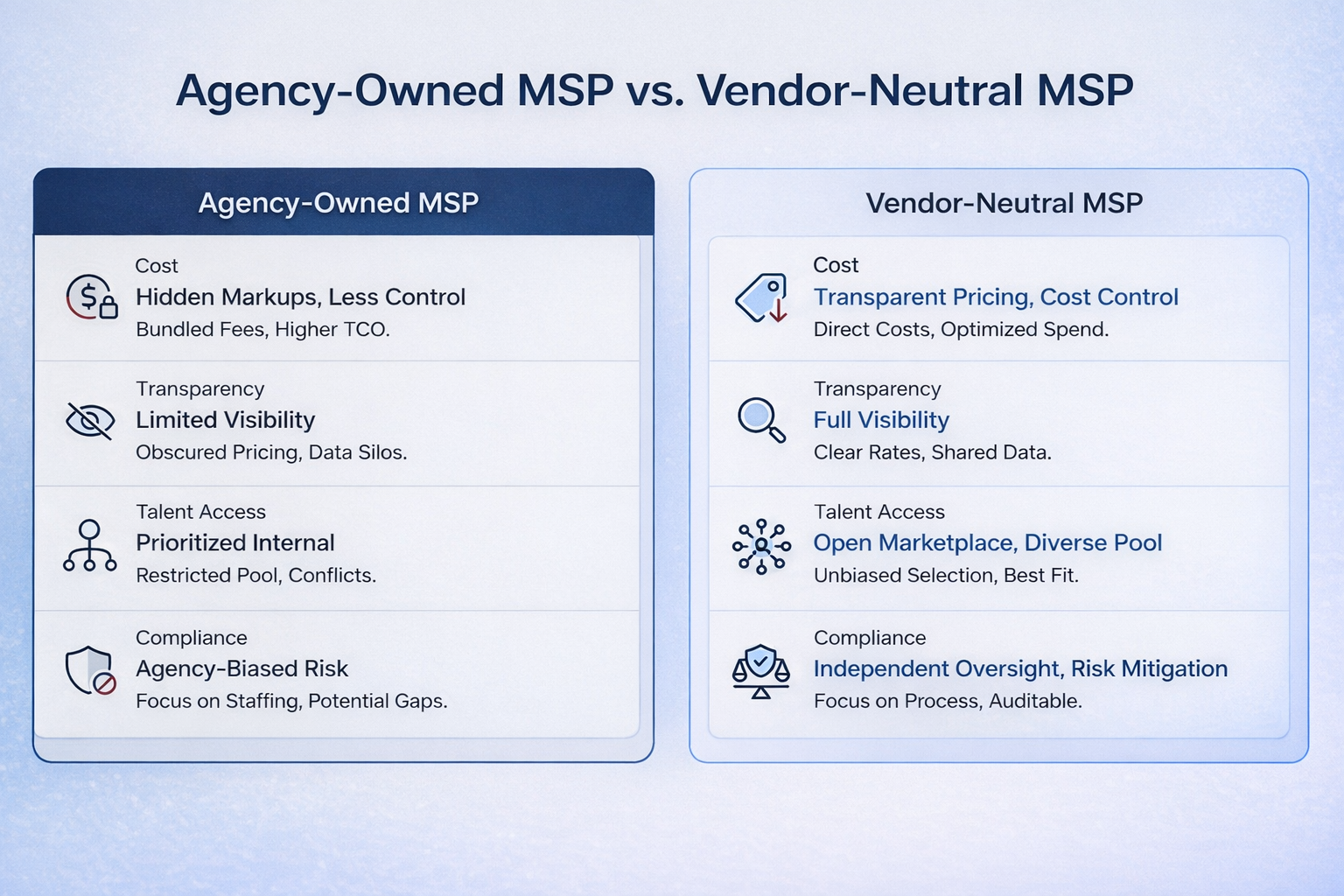
When an MSP is owned by or affiliated with a staffing agency, they have a vested interest in placing their own candidates. This creates a fundamental misalignment. The MSP is supposed to be your advisor, helping you find the best talent across the entire market. But they're also a competitor to the other staffing agencies in their network, motivated to capture as much placement revenue as possible.
According to a survey by Hallmark Health Care Solutions, nearly three-quarters (70.37%) of staffing agencies see less success when an MSP manages recruiting and placements with hospitals. An overwhelming 82.14% said they prefer not to work with VMS technology that is owned by another staffing company.
The reason is clear. A competitor-owned MSP is incentivized to give themselves advantage in the staffing process. They need to fill a significant portion of your open needs internally to make their business model work. This means your access to the broader talent market is deliberately constrained.
The Cost Inflation Effect
Agency-owned MSPs often charge higher rates that reflect their monopolistic position rather than genuine value. When vendor selection isn't truly competitive, you lose the price pressure that comes from multiple suppliers bidding for the same requisition.
Research on healthcare mergers has shown that consolidations typically lead to increased costs without corresponding improvements in service or quality. The same dynamic plays out in staffing. When your MSP prioritizes their own agency, you're not getting competitive rates. You're getting whatever rates they decide to charge.
The Transparency Gap
Agency-owned MSPs often operate with opaque practices regarding vendor selection, staffing placement, and reporting. This lack of transparency undermines your ability to make informed decisions and leads to heightened concerns about conflicts of interest.
A Magnit survey of contingent workforce management leaders found that 65% of organizations are concerned about conflicts of interest when working with MSP providers owned by or tied to specific staffing agencies. The same percentage have experienced limitations or biases in their staffing programs.
Marginalization of Quality Vendors
When an MSP prioritizes their own agency, smaller high-quality vendors get pushed to the margins. These specialized agencies might have exactly the niche talent you need, but they're not getting a fair shot at filling your requisitions.
The result is a skewed playing field where your access to talent is limited not by market availability, but by your MSP's business interests.
How Vendor Neutrality Eliminates Conflicts of Interest
Vendor neutral staffing eliminates conflicts of interest by removing the structural conditions that create them. Here's how the mechanisms work in practice.
Unbiased Supplier Selection
In a vendor-neutral MSP, all staffing suppliers are treated equally and evaluated based on the same set of standards. Decisions aren't influenced by personal relationships, company history, or special agreements. Instead, suppliers are assessed on measurable factors: quality of candidates, response time to job requests, and performance against service levels.
The goal is ensuring job roles are filled by the best available candidates, regardless of which supplier submitted them. This approach encourages healthy competition among vendors and drives overall service quality up.
Transparent Processes
Transparency is central to the vendor-neutral model. Each step in the recruitment process, from distributing job requisitions to reviewing and selecting candidates, follows clearly documented procedures. These guidelines are shared with all involved parties: clients, hiring managers, and staffing agencies.
Because the process is open and traceable, it's easier for organizations to understand how decisions are made. This builds trust among suppliers and stakeholders while ensuring hiring outcomes are consistent and aligned with business goals.
Client-Defined Rules for Order Distribution
One of the core principles of vendor-neutral staffing is that job order distribution is guided by the client, not the MSP's preferences. Clients define the rules and logic for how job requisitions are shared among suppliers.
Common distribution methods include:
- Round-robin: Job orders rotate among suppliers to ensure fairness
- Performance-based ranking: Suppliers with higher scores receive more opportunities
- Tiered models: Vendors are grouped into tiers and selected based on priority rules
Because the rules are client-controlled and system-driven, the MSP has no ability to favor any specific supplier. This structure supports equal access and aligns the staffing process with your priorities.
Objective Performance Measurement
Vendor-neutral MSPs evaluate all suppliers using the same set of metrics: fill rate, time-to-submit, candidate quality, and compliance adherence. These evaluations inform future distribution decisions, not personal preferences or past relationships.
The result is a data-driven approach where high-performing vendors get more opportunities regardless of their size or relationship with the MSP. Underutilized but high-quality vendors get a fair chance to compete, which leads to better candidate quality overall.
A vendor-neutral program is a staffing supplier's dream. It allows agencies to focus on finding amazing talent instead of worrying about internal competition from an MSP.
"Why Choose Ringo" emphasizes this vendor-neutral approach, ensuring healthcare organizations get unbiased access to the entire talent market.
The Business Impact: Costs, Quality, and Compliance
The benefits of vendor-neutral staffing aren't just theoretical. Organizations that make the switch see measurable improvements across cost, talent access, and risk management.
Cost Savings That Stick
When an MSP is first implemented, it's relatively easy to attain 8-10% in savings during the first 12 months. The real test comes after a few years, when you find out whether those savings are sustainable.
Organizations using vendor-neutral MSPs report sustainable cost reductions see cost savings between 7.5% and 15% in the initial year of their program.
The savings come from several sources:
- Competitive bidding drives down rates
- Elimination of hidden markups from preferred agencies
- Better visibility into spend patterns enables optimization
- Reduced maverick spending as confidence in the program grows
Improved Talent Access
The Magnit survey found that organizations working with vendor-neutral MSPs are 61% more likely to be "extremely satisfied" with talent access compared to those using staffing-affiliated MSPs. They're also 55% more likely to be satisfied with access to diverse talent pools.
This makes sense. When job openings are distributed to multiple approved staffing agencies simultaneously, you get access to a larger and more diverse pool of talent. This is particularly valuable for hard-to-fill roles, seasonal needs, or high-volume hiring.
Stronger Compliance and Risk Management
Vendor-neutral MSPs are 58% more likely to deliver "extremely satisfied" experiences with compliance and risk management. This is because neutral models include formal processes for managing every aspect of the staffing lifecycle, supported by technology that tracks all supplier interactions.
When everything is documented and auditable, organizations are better positioned to reduce risk, pass audits, and respond to compliance inquiries quickly.
Real-World Proof: the Novartis Case Study
Jack Schink, former director of procurement at pharmaceutical giant Novartis, documented his organization's transition from a staffing-agency MSP to a vendor-neutral model. The results were significant:
- Approximately 8% year-over-year sustainable savings
- Maverick spending brought under control
- Increased program adoption across the organization
- Improved hiring manager satisfaction
- Better compliance and risk management
The key difference? The vendor-neutral provider could reach out directly to suppliers and request objective input without them feeling their ideas would be shared with competitors. This brought new strategies and initiatives that wouldn't have emerged in a conflicted model.
You can explore similar results in Ringo's case studies, which document cost savings and efficiency improvements for healthcare organizations using their vendor-neutral VMS.
Master Vendor vs Neutral Vendor: Understanding the Difference
These terms are often confused, but they describe fundamentally different models with very different implications for conflicts of interest.
Master Vendor Model
In a master vendor arrangement, one primary staffing agency receives all job orders first. This agency may fill the positions itself or subcontract to secondary vendors. Because the master vendor benefits directly from placing candidates, there's less incentive to distribute jobs fairly or transparently.
Master vendor setups offer simplicity, but they can limit supplier diversity and lead to biased candidate selection. The master vendor has a financial interest in maximizing their own placements, which creates the same conflict of interest found in agency-owned MSPs.
Neutral Vendor Model
A neutral vendor manages vacancies on behalf of the client but is not a recruitment agency. They have no financial stake in which staffing supplier fills a requisition. Their revenue comes from program management fees, not placement commissions.
The key difference is in how job orders are assigned and how supplier competition is managed. Vendor neutrality minimizes bias and ensures consistent application of staffing policies.
When to Choose Each
Master vendor works when you have a trusted staffing partner, low hiring volume, and prefer a simple, direct relationship. The trade-off is less competition and potential conflicts of interest.
Neutral vendor is the right choice when fairness, supplier diversity, and cost control are priorities. If you're managing multiple staffing agencies across regions or job categories, or if you want better visibility into hiring decisions, vendor neutrality is the better model.
For organizations evaluating these options, Ringo's VMS or MSP guide provides additional context on selecting the right workforce management approach.
Red Flags: How to Spot Non-Neutral MSPs
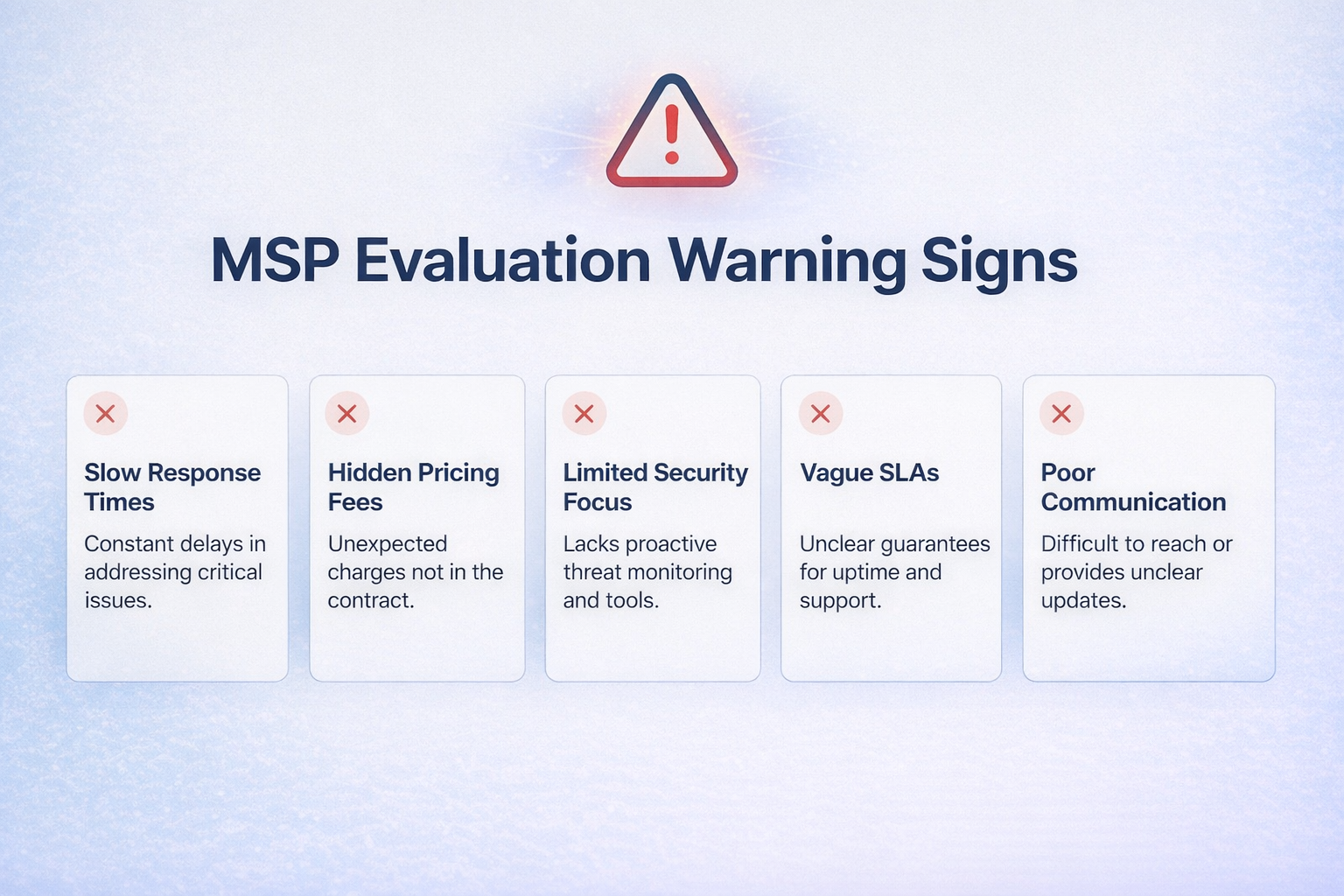
If you're evaluating MSPs or auditing your current provider, these warning signs indicate potential conflicts of interest.
Ownership Opacity
Be direct with your questions. Who owns the MSP? Is there any staffing agency affiliation? A truly neutral provider will be transparent about their ownership structure. Evasive answers or complicated corporate structures that trace back to staffing agencies are red flags.
Unclear Job Distribution
Can your MSP show you exactly how orders are distributed among suppliers? Do they provide reports showing the percentage of requisitions each vendor receives? If distribution logic is opaque or they can't demonstrate fair allocation, you may have a neutrality problem.
Limited Vendor Performance Data
A neutral MSP should provide detailed vendor-by-vendor performance metrics: fill rates, time-to-submit, candidate quality scores, and compliance ratings. If you only get aggregate data or summary reports that obscure individual vendor performance, ask why.
Concentrated Supplier Base
Is your supplier network dominated by a few "preferred" agencies that seem to get the lion's share of requisitions? While some vendors naturally perform better and earn more opportunities, extreme concentration may indicate favoritism rather than merit-based distribution.
Resistance to Audits
Will your MSP allow independent audits of their neutrality practices? A confident, truly neutral provider should welcome this verification. Resistance to external review suggests they may have something to hide.
For more guidance on evaluating workforce management solutions, see Ringo's VMS 101 FAQ.
Building a Conflict-Free Contingent Workforce Program
If you've identified conflicts in your current staffing program, or if you're setting up a new contingent workforce management approach, here's how to build neutrality into the foundation.
Evaluate Your Current State
Start by assessing your existing MSP against the red flags outlined above. Review your vendor distribution data, examine ownership structures, and interview your staffing suppliers about their experience. If you find conflicts, quantify their impact on your costs and talent access.
Define Client-Controlled Distribution Rules
Work with your MSP (or a new vendor-neutral provider) to establish clear rules for job distribution. These should be documented, transparent to all suppliers, and aligned with your priorities. Common approaches include round-robin distribution, performance-based ranking, or tiered models based on specialty or geography.
Implement Technology That Enforces Neutrality
A VMS platform should automate job distribution according to your rules, eliminating the potential for manual bias. Look for systems that provide real-time visibility into the entire process, from requisition to placement.
Establish Objective Vendor Scorecards
Define the metrics that matter for your organization: fill rate, time-to-fill, candidate quality, compliance adherence, and cost competitiveness. Measure all vendors against these same standards and use the data to inform distribution decisions.
Create Transparent Reporting
Ensure all stakeholders, including staffing suppliers, have access to performance data and distribution reports. Transparency builds trust and makes it easier to spot potential issues before they become problems.
Consider a Vendor-Neutral Alternative
If your current MSP can't or won't address conflicts of interest, it may be time to explore alternatives. Ringo provides a vendor-neutral VMS designed specifically for healthcare organizations, with features like automated job distribution, real-time analytics, and compliance tracking.
You can book a demo to see how a vendor-neutral approach would work for your organization, or explore healthcare-specific solutions tailored to hospital and health system needs.