

In this article
It's Tuesday morning at a 25-bed critical access hospital. The diabetes educator is out this week. The home health agency down the road just said it can't take another referral. And the state has announced its share of new federal rural health money.
The money is coming. Finding people to do the work is the hard part.
November is Diabetes Month and Home Care & Hospice Month. National Rural Health Day is November 19. And most health systems are setting their 2027 budgets right now. If you run a rural or multi-site system, all of that comes back to one question: who is going to deliver the care?
Rural patients need more chronic care
The CDC puts diagnosed diabetes at 12.3% of rural adults, compared with 9.3% of urban adults. Managing diabetes takes nurses, NPs, educators, dietitians and pharmacists working together. A big urban system might have several of each. A rural hospital often has one of each, or none.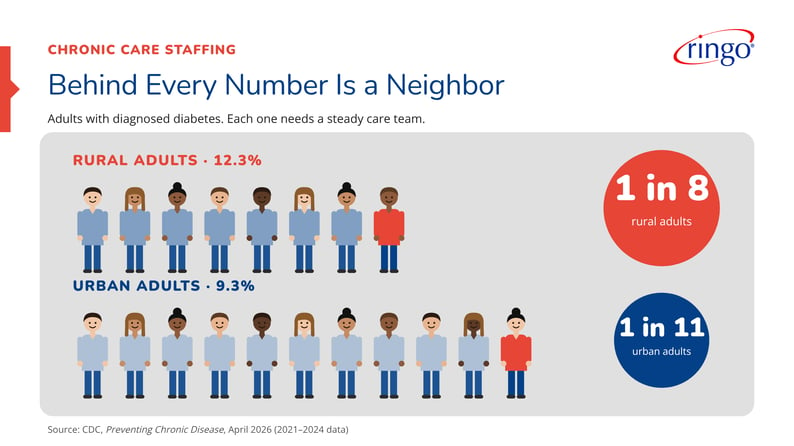
Source: CDC, Preventing Chronic Disease, April 2026
So when one person leaves, the program stops. Classes get cancelled. Follow-ups slip. Patients who were finally stable start to struggle.
The fix usually isn't a bigger budget. It's getting the opening in front of more qualified clinicians, faster. In Ringo's healthcare vendor management system, an opening goes out once to every approved supplier instead of the one or two agencies you always call. That makes it much less likely a single vacancy shuts a program down.
Much of that care happens at home
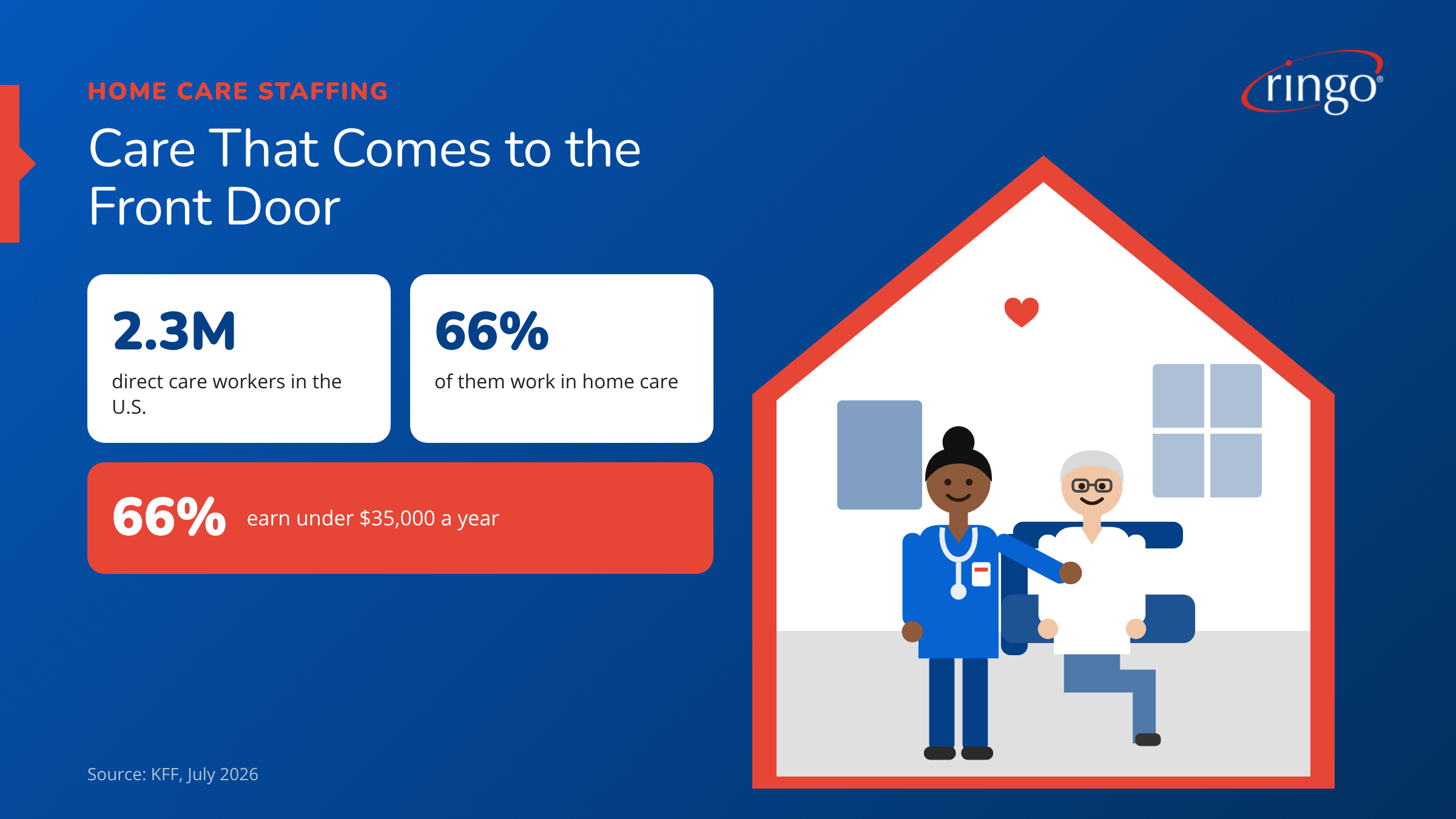
A lot of chronic and end-of-life care happens in patients' homes, and the people doing it are stretched. KFF counts about 2.3 million direct care workers in the U.S. About 66% of them work in home care, and 66% earn under $35,000 a year. Medicaid cuts, immigration limits and proposed changes to labor rules will add more pressure.
Nurses feel it too. In AMN Healthcare's 2026 survey, 85% said staffing problems had disrupted care, and only 51% plan to stay with their current employer. Home care and hospice patients count on seeing the same faces, so turnover hits them hardest.
Part of the problem is that nobody can see the whole workforce. Hospital staff are in one system, home care in another and per diem in a spreadsheet, so thin coverage goes unnoticed until it breaks. Health systems using Ringo put all of those workers in one view. Gaps show up earlier, and it's easier to keep the same clinicians with the same patients.
New funding is a staffing test
The Rural Health Transformation Program provides $50 billion through 2030, and CMS awarded the first $10 billion for 2026. Many states have put workforce recruitment and retention near the top of their plans.
That money arrives as other money leaves. HFMA estimates $137 billion in Medicaid cuts will hit rural healthcare over the next decade. Funding can build a clinic, but you need clinicians to keep it open, and the faster they're credentialed, the sooner they're seeing patients. Ringo keeps credentialing in one place, which gets new educators and NPs to patients sooner.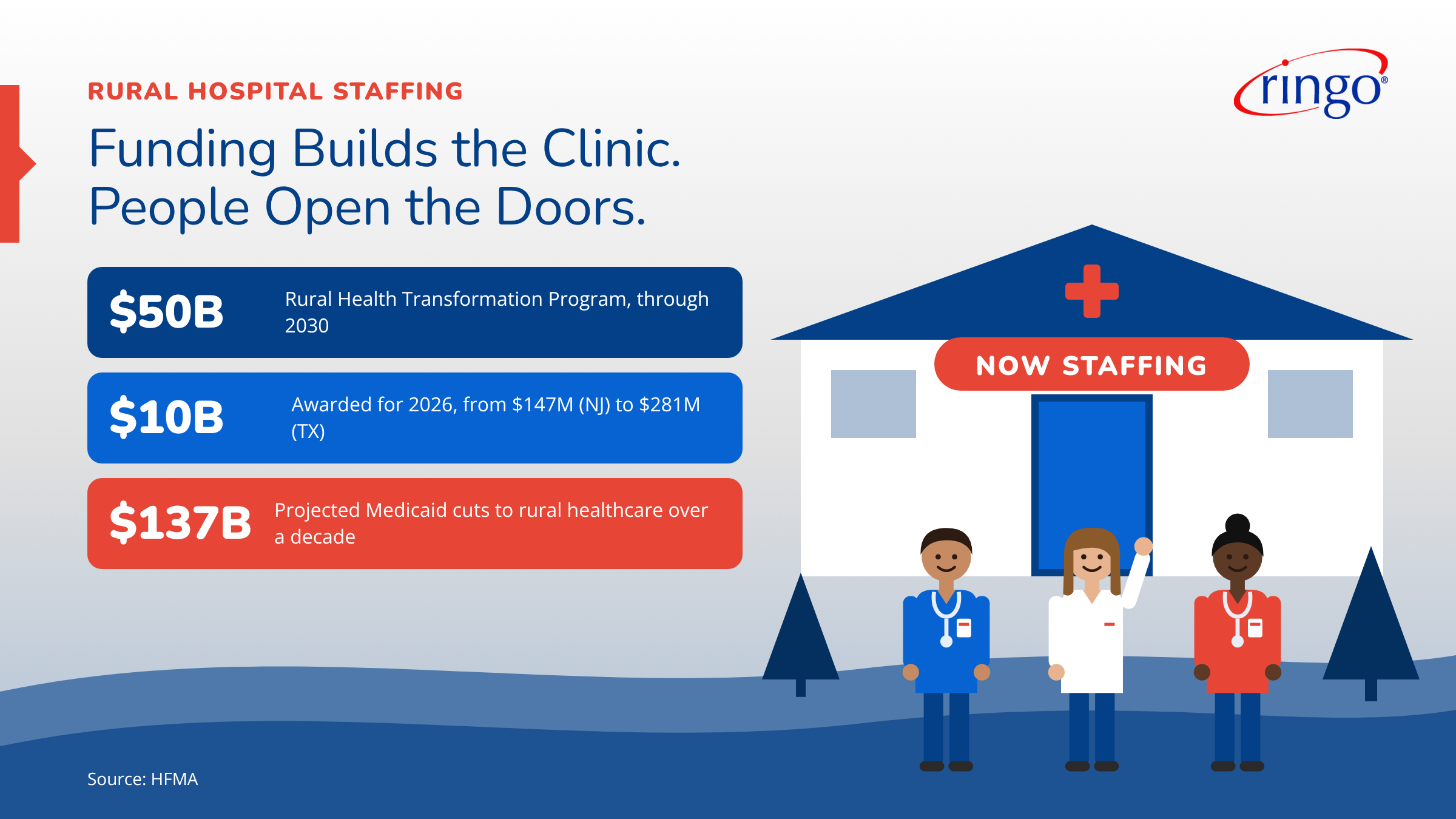
Source: HFMA, CMS distributes $10 billion for states to use to improve rural healthcare
Where to start for 2027
- Map chronic care roles by site. Know where one vacancy would stop a program.
- Put every worker in one view. That includes hospital, home care and per diem staff.
- Widen your supplier bench. Rural shifts fill faster when more agencies compete for them. Ringo doesn't own a staffing agency, so every supplier gets a fair shot at the work.
- Track continuity, not only fill rate. Chronic care patients do better with clinicians they already know.
- Attach a staffing plan to every funded program. Know who will do the work before the money is spent.
Back at that critical access hospital, here's how it plays out. The educator opening is posted once and reaches every approved supplier, and a credentialed clinician fills it. Nobody spends the morning calling agencies one at a time.
The bottom line
Rural funding is a real opportunity, but money doesn't see patients. Health systems that plan staffing for chronic care, home care and hospice now will be the ones that turn 2026 dollars into 2027 care.
See how Ringo helps rural and multi-site health systems staff chronic and home care.