
Agency-Owned VMS: What Your Platform Isn't Telling You

Most hospital systems assume their vendor management system is a neutral technology — a platform that objectively connects them with staffing agencies, tracks compliance, and manages spend. That assumption is costing them millions.
The uncomfortable truth: a significant portion of the VMS platforms used in healthcare today are owned by, affiliated with, or financially entangled with the staffing agencies they're supposed to neutrally manage. And that conflict of interest is built directly into the software running your contingent workforce program.
This isn't a theoretical concern. It's a structural problem with measurable financial consequences — and most health systems don't find out until they've already signed a multi-year contract.
First: What Is an Agency-Owned VMS?
An agency-owned VMS is a vendor management system where the technology platform is owned by, operated by, or financially affiliated with a staffing agency that also competes for your open positions.
This happens more often than most facilities realize: a major healthcare staffing company acquires or builds a widely used VMS platform, then both operates that platform and competes as a vendor on it. The agency controls the technology your requisitions flow through while simultaneously bidding to fill those same requisitions.
Many MSP-managed programs operate similarly: the company running your VMS is itself a staffing agency, with every incentive to route your open requisitions to their own candidates before competitors ever see them.
This structure is so pervasive that industry observers have described it as a fundamental conflict baked into how healthcare staffing programs are structured [BlueSky Medical Staffing]. When the referee also plays on one of the teams, the game is never fair.
What Your Platform Isn't Telling You
If your VMS is agency-owned or agency-affiliated, here are five things the platform's dashboard will never surface.
1. Your agency pool is smaller than it should be
A vendor-neutral platform distributes your requisitions to every qualified agency simultaneously, creating genuine competition. An agency-owned platform has a built-in incentive to fill positions internally first — or to make it structurally harder for competing agencies to succeed.
82% of staffing agencies report they prefer not to work with a VMS owned by a competing staffing company — and many simply don't [BlueSky Medical Staffing]. That means your agency-owned platform may be systematically excluding vendors who could offer better candidates at better rates.
2. You're paying inflated rates you can't see
When competition is suppressed — when fewer agencies bid on your requisitions — the natural market pressure that drives down bill rates disappears. You're left paying whatever the affiliated agency charges, with no competitive benchmark.
According to Staffing Industry Analysts, travel nurses cost hospitals an average of 177% more than their permanent staff counterparts. That premium is compounded when there's no competition to push rates down.
Healthcare staffing markups routinely reach 100% or more — and when the platform controlling vendor access is owned by one of the vendors, there's no structural mechanism to challenge those rates [VarsHealth].
3. MSP fees stack on top of markups — quietly
Many agency-owned programs also collect MSP program fees on top of the agency markup. The industry-standard MSP fee is 2–3.5% of total contingent workforce spend [VarsHealth]. On a $10 million annual contract labor budget, that's $200,000–$350,000 per year — paid to the same entity that's also competing to fill your open shifts.
This fee is often buried in the program agreement, presented as a technology cost. It's not a technology cost. It's a margin layer extracted by a company with a direct financial interest in the outcome.
4. Your compliance data isn't fully yours
Agency-owned platforms control your credentialing records, compliance history, vendor performance data, and workforce analytics. When the company that manages that data is also a staffing vendor, there are legitimate questions about data portability, vendor scoring methodology, and whether performance rankings are truly objective.
If you ever want to leave — to switch platforms or bring the program in-house — you may find your own data is harder to export than expected. Platform lock-in is a feature, not a bug, when the platform is owned by a company that profits from keeping your program.
5. The financial stakes are larger than most realize
U.S. hospitals spend over $51 billion annually on contract labor, and 73% of travel nurse revenue in 2024 was routed through an MSP [PRN Funding]. The majority of contingent healthcare labor in America now flows through programs where the technology platform and the staffing vendor are, in many cases, the same company.
Even a 10% cost inefficiency on $51 billion is $5.1 billion in annual waste across the industry. For a single 500-bed hospital system spending $15 million per year on contract labor, a 15% reduction from genuine vendor competition returns $2.25 million to the bottom line every year.
The Real-World Cost of Agency Ownership
The financial impact of switching from an agency-affiliated program to a vendor-neutral platform has been documented across the industry.
One health organization reported saving $1.57 million on agency spend after implementing neutral VMS technology — driven almost entirely by competitive vendor access that hadn't existed before [HWL Works]. Research consistently shows that vendor-neutral programs reduce contract labor costs by 10–25% compared to agency-controlled alternatives [BlueSky Medical Staffing].
The mechanism is straightforward: competition works. When every qualified agency sees every requisition at the same time, they compete on speed, quality, and price. That competition disappears when the platform has a stake in who wins.
In a recent blog, Ringo's vendor-neutral VMS analysis further explores how program structure directly drives staffing costs.
How to Tell If Your VMS Is Agency-Owned
The ownership structure of VMS platforms isn't always prominently disclosed. Here are the questions to ask:
- Who owns the VMS platform? Ask directly — and ask for documentation. "We are a neutral technology provider" is not the same as "we have no equity, ownership, or revenue-sharing relationship with any staffing agency."
- Does the MSP running your program also fill positions? If your MSP both manages the platform and submits candidates, it is not neutral — regardless of what the contract says.
- How are vendor performance scores calculated? Ask to see the methodology. If it's proprietary or unavailable, that's a meaningful answer.
- Who owns your data? Read the data portability and exit provisions in your contract carefully. Difficulty exporting your own credentialing and compliance records is a red flag.
- How many agencies actively participate on the platform? Compare this to the full universe of agencies serving your market. A gap signals restricted access.
What Vendor Neutrality Actually Means
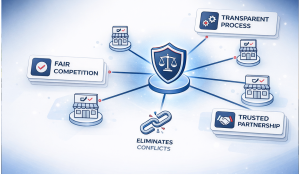
Vendor neutrality isn't a marketing phrase — it's a structural commitment. A genuinely vendor-neutral VMS has no equity ties, revenue-sharing arrangements, or affiliated agencies. It earns its fee from the health system it serves, not from the vendors competing on its platform.
That distinction changes the incentive structure of the entire program:
- Every agency competes on equal footing
- Bill rates are set by the market, not by an affiliated vendor
- Compliance and performance data is objective
- Your program serves your interests — not the interests of the company that built the software
Ringo is the only vendor-neutral talent management system purpose-built for healthcare. We have no staffing agency relationships to protect, no affiliated vendors to favor, and no financial interest in which agencies fill your positions. Our only interest is in giving your health system the visibility, control, and competitive market dynamics you're paying for.
The Question Every Health System Should Be Asking
With 54% of healthcare facilities relying on agency staffing to cover chronic shifts weekly, contingent workforce management isn't a back-office function — it's a core operational and financial strategy [PRN Funding]. The platform running that program deserves the same scrutiny as any major vendor relationship.
The right question isn't "does our VMS work?" The right question is: Who does our VMS work for?
If you don't know the answer, it's time to find out.
Want to see what a genuinely vendor-neutral VMS looks like — and what it would mean for your contract labor costs?