

In this article
Hospitals today are navigating one of the most challenging staffing environments in modern healthcare. With over $51 billion spent annually on contract labor and nurse vacancy rates hovering between 10-15% nationwide, healthcare leaders are under immense pressure to do more with less. A Vendor Management System (VMS) has emerged as a critical tool for hospitals looking to regain control over their workforce spending while maintaining quality patient care.
Let's break down the top healthcare VMS benefits that are driving adoption in 2026 and why your hospital should consider making the switch.
What is a Healthcare Vendor Management System (VMS)?
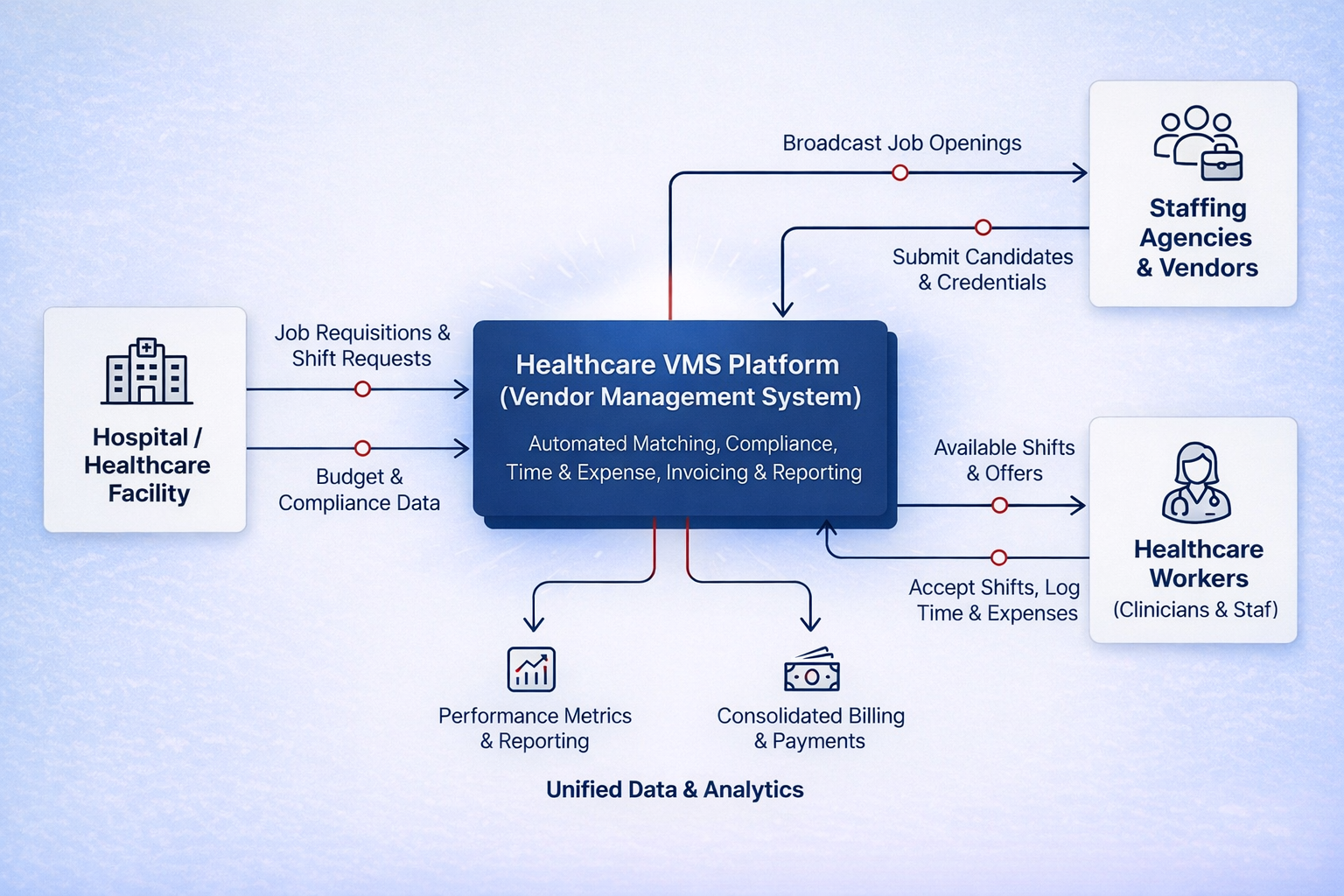
A healthcare Vendor Management System (VMS) is a technology platform that centralizes how hospitals manage contingent staff and third-party staffing vendors. Instead of juggling spreadsheets, phone calls, and emails across dozens of agencies, a VMS puts everything in one place: requisitions, credentialing, compliance tracking, scheduling, and billing.
Here's the short version: it's command central for your contingent workforce.
Healthcare VMS platforms differ from general workforce management tools because they're built specifically for the complexities of clinical staffing. They understand that a travel nurse needs different credentialing than a warehouse temp, and that Joint Commission compliance isn't optional.
There are two main models to understand:
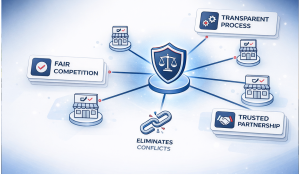
- Vendor-neutral VMS: These platforms (like Ringo) don't own staffing agencies themselves. They give hospitals access to competitive rates from multiple vendors without conflicts of interest.
- MSP-owned VMS: These are run by Managed Service Providers who may also own or have preferred relationships with specific staffing agencies. This can limit your access to the full talent pool.
The distinction matters because it affects both your costs and your access to qualified candidates.
The 2026 Healthcare Staffing Landscape
To understand why VMS adoption is accelerating, you need to look at the numbers. The healthcare staffing market is projected to reach $82.92 billion by 2034, growing at nearly 7% annually. Meanwhile, the Association of American Medical Colleges projects a physician shortage of up to 86,000 by 2036.
Over 70% of hospitals already rely on temporary healthcare workers to bridge gaps. The problem? Most are still managing this massive spend through manual processes that create bottlenecks, compliance risks, and budget overruns.
2026 is shaping up to be a pivotal year for several reasons:
- Economic pressures are forcing hospitals to scrutinize every dollar of labor spend
- Regulatory changes around Medicaid and Medicare reimbursement are tightening margins
- Technology maturity means VMS platforms now offer capabilities that weren't available even three years ago
- Workforce expectations have shifted, with clinicians expecting mobile access and faster onboarding
The hospitals thriving in this environment are the ones treating workforce management as a strategic function, not just an administrative one. For more on the challenges facing healthcare workforce management, see our analysis of Burnout, Turnover, and Cost: The Hidden Workforce Crisis Facing Healthcare in 2026.
Here are the top 5 healthcare vendor management system (VMS) benefits for hospitals in 2026:
1. Cost Reduction and Financial Control
Let's talk numbers. Hospitals using a VMS typically see a 25% reduction in vendor management costs. Some platforms deliver even more: Atlas Systems reports their ComplyScore VMS reduces onboarding costs by up to 60% and cuts vendor onboarding time from the industry average of 45-60 days down to 15-20 days.
Where do these savings come from?
Real-time spend visibility is the foundation. Without a VMS, most hospitals can't tell you exactly how much they're spending on contract labor until the bills come in, often weeks later. A VMS shows you spending as it happens, broken down by department, vendor, and role type.
Rate standardization prevents the "same nurse, different price" problem. When every department negotiates independently with staffing agencies, you end up paying wildly different rates for identical roles. A VMS centralizes rate cards and flags anything that doesn't match.
Automated billing eliminates the invoice errors that plague manual processes. Ringo, for example, maintains a 98% invoice accuracy rate and reduces average billing cycles to under 14 days. That means fewer disputes, faster payments, and better relationships with your vendors.
Competitive bidding ensures you're getting market rates. When multiple agencies can see and respond to your open requisitions, the market drives pricing rather than your incumbent vendor's rate card.
Bottom line? The ROI on a VMS typically pays for itself within the first year through cost avoidance alone. You can estimate your potential savings using our specialized ROI calculator designed specifically for healthcare labor spend analysis.
2. Automated Compliance and Credentialing
In healthcare, compliance isn't a checkbox, it's a patient safety imperative. One expired license or missing background check can create liability exposure and put patients at risk. The challenge is that tracking credentials across hundreds of contingent workers from dozens of vendors is nearly impossible to do manually.
A healthcare VMS solves this through automation:
Real-time credential tracking monitors licenses, certifications, and training records across your entire contingent workforce. When a nurse's license is approaching expiration, the system flags it automatically.
Automated compliance checks verify that every worker meets your requirements before they step foot in your facility. This includes Joint Commission standards, HIPAA compliance, state licensing requirements, and hospital-specific privileging.
Proactive alerts give you advance warning of expiring credentials, not after the fact. Most platforms send notifications 30, 60, or 90 days before expiration, giving you time to renew without last-minute scrambles.
Audit trails document everything for regulatory inspections. When The Joint Commission or state surveyors arrive, you can pull comprehensive reports showing compliance status across your entire contingent workforce in minutes, not days.
The result is what Ringo calls "100% compliance from submission to onboarding." Every worker in your facility has been verified, every credential has been checked, and every requirement has been met. For hospitals, this means reduced risk, faster onboarding, and peace of mind.
Learn more about how automated credentialing and compliance management work in practice.
3. Workforce Visibility and Analytics
You can't manage what you can't measure. Yet most hospitals have surprisingly little visibility into their contingent workforce beyond total spend. A VMS changes this by providing real-time analytics on the metrics that matter.
Fill rates and time-to-fill show how quickly your staffing needs are being met. Are certain departments consistently waiting weeks for placements while others fill shifts in days? A VMS reveals these patterns so you can address root causes.
Vendor performance scoring tracks which agencies deliver quality candidates on time, and which ones consistently miss the mark. Over time, this data helps you optimize your vendor mix, focusing spend on the partners who perform.
Predictive analytics help you anticipate staffing needs before crises hit. By analyzing historical patterns, seasonal trends, and current census data, a VMS can forecast when you'll need additional staff and help you secure them proactively rather than reactively.
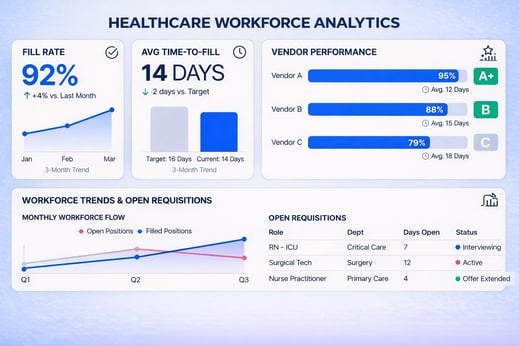
Ringo Vitals takes this a step further with an interactive dashboard that transforms static metrics into drill-down KPIs. Instead of just seeing that your fill rate is 85%, you can click through to see which units, which shifts, and which vendors are driving that number.
This level of visibility enables data-driven workforce planning. Instead of relying on gut feel or historical precedent, you can make staffing decisions based on actual performance data. For more on the reporting capabilities that make this possible, explore our dashboard and reporting features.
4. Operational Efficiency and Time Savings
Administrative burden is one of the hidden costs of contingent staffing. HR teams and nurse managers spend hours on repetitive tasks: posting requisitions, verifying credentials, processing timesheets, reconciling invoices. A VMS automates these workflows, freeing your team to focus on higher-value work.
The efficiency gains are substantial:
- 60% reduction in administrative burden is typical after VMS implementation
- Time-to-fill drops from weeks to days when requisitions are posted to multiple vendors simultaneously
- Automated onboarding streamlines everything from credential submission to scheduling
- Mobile access lets managers approve shifts, review candidates, and track spending from anywhere
The workflow transformation is significant. Instead of phone tag with staffing agencies, managers post needs to a central platform where all approved vendors can respond. Instead of manually checking credentials against multiple databases, the VMS verifies everything automatically. Instead of reconciling paper timesheets against invoices, time tracking and billing are integrated.
For nurse managers specifically, this efficiency gain is critical. They're already stretched thin managing full-time staff, patient care, and administrative duties. Giving them back hours each week through automation directly impacts retention and job satisfaction. See how VMS technology supports nurse managers in their day-to-day operations.
The onboarding and scheduling capabilities of a modern VMS are designed specifically to reduce this administrative overhead while improving the experience for both managers and contingent staff.
5. Vendor Neutrality and Competitive Sourcing
Not all VMS platforms are created equal when it comes to vendor access. This is where the distinction between vendor-neutral and MSP-owned systems becomes critical.
MSP-owned VMS platforms are run by staffing companies who also provide contingent workers. While they may give you access to other vendors, there's an inherent conflict of interest: they're incentivized to fill your needs with their own staff first, even if better candidates or lower rates are available elsewhere.
Vendor-neutral VMS platforms (like Ringo) don't own staffing agencies. They provide a level playing field where all approved vendors compete equally for your business. This drives several benefits:
- Broader talent pools because you're not limited to one agency's roster
- Competitive pricing as vendors bid against each other for your placements
- Quality improvements because vendors know their performance is being tracked and compared
- Strategic relationships rather than transactional dependencies
The vendor-neutral approach aligns the VMS provider's incentives with yours: they succeed when you get the best possible staffing outcomes, not when they fill shifts with their own people.
This model also supports what industry analysts are calling the shift from "vendor relationships" to "strategic partnerships." Instead of treating staffing as a commodity purchase, hospitals are building collaborative relationships with workforce platforms that align around shared goals: cost containment, quality care, and operational efficiency.
Learn more about the difference between VMS and MSP models and why vendor neutrality matters for your bottom line.
Choosing the Right Healthcare VMS for Your Hospital
If you're evaluating VMS options, here are the key questions to ask:
Is it built for healthcare? General workforce management tools often lack the compliance, credentialing, and clinical workflow features that hospitals need. Look for platforms with healthcare-specific functionality, not generic staffing tools adapted for medical use.
How does it handle integration? Your VMS needs to connect with your existing systems: HRIS, payroll, EHR, and credentialing databases. Ask about API capabilities and pre-built integrations.
What's the vendor model? Understand whether the platform is truly vendor-neutral or if there are preferred relationships that could limit your options.
What does implementation look like? A VMS is only valuable if your team actually uses it. Ask about training, change management support, and typical time-to-value.
How does it scale? A solution that works for a 200-bed community hospital may not meet the needs of a multi-state health system. Make sure the platform can grow with you.
For smaller and rural hospitals, there are additional considerations around budget, IT resources, and specialized support needs. Our guide on rural hospital workforce management technology explores these challenges in detail.
The right VMS should feel like a strategic partner, not just another software vendor. Look for providers who understand healthcare workforce challenges and can demonstrate measurable results at organizations similar to yours.
Transform Your Healthcare Workforce Management in 2026
The hospitals thriving in 2026 are treating workforce management as a strategic function, not just an administrative necessity. A VMS delivers the visibility, control, and automation needed to navigate today's staffing challenges while positioning your organization for long-term resilience.
The benefits are clear and quantified: 25% cost reductions, 60% administrative time savings, 100% compliance automation, and real-time visibility into your entire contingent workforce. For hospitals spending millions annually on contract labor, these improvements translate directly to the bottom line.
But beyond the numbers, a VMS enables a fundamental shift in how you approach staffing. Instead of reactive, crisis-driven hiring, you can move to proactive workforce planning. Instead of transactional vendor relationships, you can build strategic partnerships. Instead of administrative burden, your team can focus on patient care.
2026 is the year to move beyond the old vendor model. The technology is mature, the ROI is proven, and the competitive pressure to optimize has never been greater.
Ready to see what a vendor-neutral VMS can do for your hospital?
Book a demo with Ringo and discover how healthcare organizations are transforming their workforce management. Or explore our healthcare solutions to learn more about our approach to hospital workforce challenges.