


The locum tenens market has more than doubled since 2019 — rising from roughly $5.2 billion to a projected $9.6 billion in 2025 [PRN Funding]. Physician shortages are accelerating. Hospitals are leaning harder on locum coverage than ever before.
And yet, most hospitals still manage their locum tenens programs the same way they did a decade ago: spreadsheets, email chains, phone calls, and a fragmented roster of agencies with no standardized process.
That mismatch — a growing, high-stakes program managed with manual tools — is exactly where locum tenens vendor management software changes everything.
The Real Cost of Manual Locum Management
Locum tenens isn't a simple line item. Every locum placement involves credentialing verification, malpractice coverage confirmation, privileging, scheduling, timekeeping, and invoicing. Multiply that across dozens of placements and multiple staffing agencies, and the administrative complexity compounds fast.
Without a centralized system, hospitals are operating with significant blind spots:
- No unified view of locum spend across departments and facilities
- Credentialing tracked manually — with no automated alerts for expiring licenses or certifications
- Fragmented vendor relationships with no rate benchmarking or performance tracking
- Invoices arriving from multiple agencies with no consolidated billing
- No data to support smarter staffing decisions or forecast future needs
The result: overpayment, compliance risk, and an administrative burden that falls on already-stretched staffing coordinators.
What Locum Tenens Vendor Management Software Actually Does
Locum tenens vendor management software is a technology platform that centralizes every step of the locum staffing lifecycle — from requisition to payment — in a single system. Think of it as the operational command center for your physician and advanced practice staffing program.
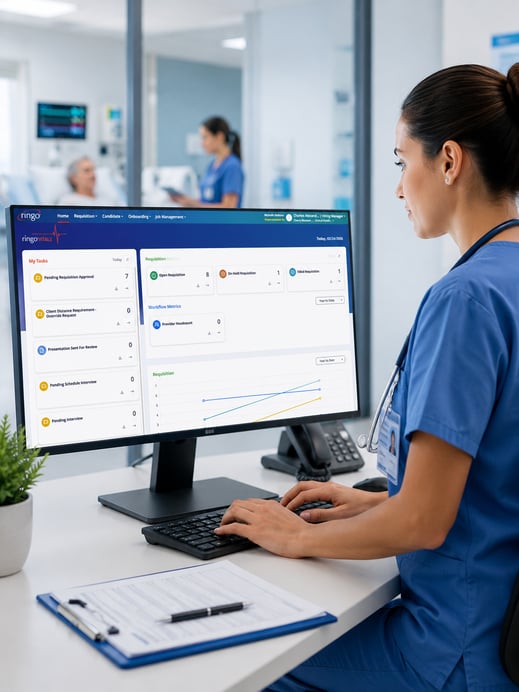
Here's what a purpose-built locum VMS handles end-to-end:
Requisition and Vendor Distribution
When a department needs locum coverage, a requisition is created in the system with role requirements, shift details, and credential requirements. The VMS distributes that requisition simultaneously to all approved locum agencies — creating competitive submission rather than relying on a single preferred vendor.
Credentialing and Compliance Automation
Every locum provider must meet strict credentialing requirements before they can practice. A VMS automates the collection, verification, and tracking of licenses, DEA registration, malpractice coverage, immunizations, and background checks — with automatic alerts when documents approach expiration. This is where manual programs fail most visibly: a missed credential expiration is both a compliance risk and a patient safety issue.
Scheduling and Timekeeping
Locum shifts are confirmed in the platform. Providers clock in and out digitally. Timesheets are reviewed and approved without paper, fax, or email — and the data flows directly to billing.
Consolidated Invoicing
Instead of reconciling invoices from five different locum agencies, a VMS generates a single consolidated invoice covering all providers. One invoice, one payment, one audit trail.
Spend Analytics and Vendor Performance
Real-time dashboards show locum spend by department, specialty, facility, and time period. Vendor fill rates, quality scores, and rate comparisons are visible at a glance — giving you the data to make smarter sourcing decisions.
The Market Has Outgrown Manual Management
Consider the scale of what hospitals are managing. 44% of physicians who changed jobs in 2024 took a locum position [Business Wire]. The locum market is growing at 9–10% annually, with less than 30% of placements currently managed through centralized platforms [Locumsmart].
That gap — 70%+ of locum placements still managed without a VMS — represents an enormous opportunity for hospitals willing to modernize. The organizations that have centralized their locum programs are seeing measurable results: reduced cost per placement, faster time-to-fill, and dramatically less administrative overhead.
According to HWL Works, the key questions when evaluating a locum VMS come down to: Does it understand the unique complexity of physician credentialing? Can it handle the nuances of locum billing (daily rates, per diem, travel expenses)? And does it give you visibility across all your locum agencies — or does it favor one?
Locum vs. Travel Nursing: Why Separate Management Matters
Locum tenens and travel nursing are often lumped together in workforce discussions, but they require different management workflows. Physicians and advanced practitioners have longer credentialing cycles, higher placement costs, and more complex billing structures than nursing staff.
A VMS purpose-built for healthcare handles both — but the locum-specific features matter enormously: specialty-level credentialing, malpractice tail coverage tracking, privilege verification, and rate structures that include travel and housing allowances. A generic procurement tool won't have these built in.
What to Look for in a Locum Tenens VMS
Not all vendor management platforms are built for the complexity of physician staffing. When evaluating locum tenens VMS options, prioritize:
- Healthcare-native credentialing — Not just license tracking, but specialty-specific requirements, malpractice verification, and privileging workflow support
- Vendor neutrality — The platform should have no ownership ties to any locum agency. An agency-affiliated VMS has a built-in incentive to funnel placements to preferred vendors
- Locum-specific billing support — Daily rates, call pay, per diem, housing, and travel expense management built into the invoicing workflow
- Multi-facility support — Health systems with multiple sites need centralized visibility with facility-level controls
- Real-time analytics — Specialty-level spend, agency performance, fill rates, and cost-per-placement dashboards
- Integration with existing systems — Open APIs that connect with your credentialing, EHR, and payroll platforms
The Bottom Line
The locum tenens market is too large, too complex, and too strategically important to manage with spreadsheets. As physician shortages deepen and locum reliance grows, the hospitals that will gain competitive advantage are those that bring the same operational discipline to locum management that they apply to every other major spend category.
Locum tenens vendor management software isn't a luxury for large health systems. It's the infrastructure that makes a high-functioning locum program possible — at any scale.
Ringo is the only vendor-neutral talent management system purpose-built for healthcare — handling locum tenens, travel nursing, and contingent workforce management on a single platform, with no agency affiliations and no conflicts of interest.
Want to see how Ringo manages your locum tenens program end-to-end?